
At some point, usually once things are going well, this question turns up: do I need to register for VAT yet? It’s worth knowing the answer before HMRC tells you, because the threshold works on a rolling window most people don’t check until they’re already over it.
The threshold is £90,000, but not measured how most people assume
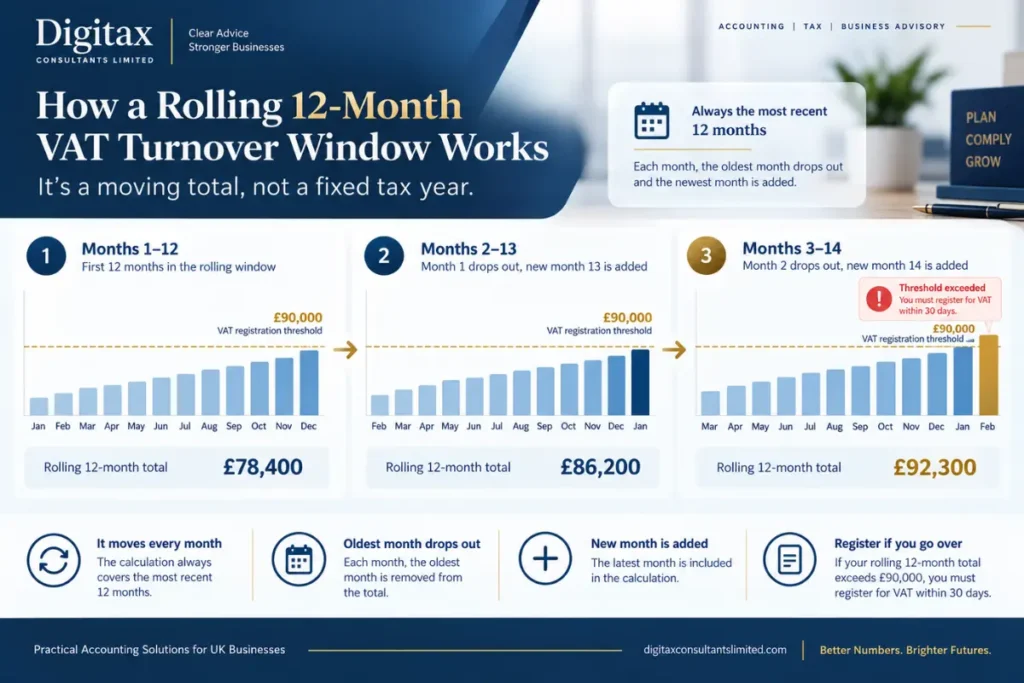
You have to register for VAT once your taxable turnover goes over £90,000. The part that catches people out is “in the last 12 months.” That’s not your tax year and it’s not the calendar year. It’s a rolling 12-month window that moves every month, so you could tip over it in November without your accounts for the year looking anywhere near £90,000 yet.
Taxable turnover means the total value of what you’ve sold that counts as taxable, standard rated, reduced rated or zero-rated. It’s not profit, and it’s not just your standard-rated sales. If you’re close to the threshold and only counting the sales that carry 20% VAT, you’re probably undercounting.
There’s a second test too: if you expect your turnover to go over £90,000 in the next 30 days alone, say you’ve just landed one large contract, you have to register straightaway rather than waiting for the 12-month total to catch up.
The 30 day clock, and why the effective date catches people out
Once you’ve gone over the threshold, you have 30 days from the end of that month to register. But your effective date of registration isn’t the day you apply. It’s the first day of the second month after you crossed the line.
Say your rolling turnover passes £90,000 in the middle of March. You’d need to register by the end of April, and your VAT registration would be backdated to 1 May, whether or not you’d registered by then. From that date, you owe VAT on your sales, even on invoices you raised before you got round to registering, because HMRC doesn’t wait for you to start charging it before deciding you should have been.
That gap between “when I noticed” and “when I was actually liable” is where most VAT registration problems come from, not the registration form itself.
What happens if you register late
HMRC calculates a penalty based on how late you were: 5% of the VAT you owe if you’re under 9 months late, 10% between 9 and 18 months, and 15% beyond that, with a £50 minimum regardless. On top of the penalty, you still owe the VAT itself, backdated to your actual effective date, whether or not you charged your customers for it at the time.
HMRC also has considerably more data than it used to, including marketplace and payment data, which makes businesses that should have registered easier to spot than they once were. None of this is a reason to panic if you’re close to the threshold. It’s a reason to check your rolling total regularly rather than once a year at account time.
Should you register before you're forced to?
You can register voluntarily below £90,000, and for some businesses it’s the better call. If most of your customers are VAT-registered businesses themselves, they can reclaim the VAT you charge them, so registering early costs them nothing and lets you reclaim VAT on your own purchases and setup costs. It also means there’s no scramble later, and no gap between “I think I’m close” and “I’m definitely over.”
It’s less obviously worth it if your customers are mostly the public rather than other businesses. Adding 20% to your prices, or absorbing it yourself, is a real decision either way, and it applies whether you’re trading as a sole trader or through a limited company; the VAT threshold doesn’t care which structure you use. It’s also worth having on your radar early if you’ve just gone through company registration, since a fast-growing new company can reach £90,000 sooner than founders expect.
What registering actually involves
Once you’re VAT registered, you charge VAT on your sales at the appropriate rate (standard 20%, reduced 5%, or zero, depending what you sell), file returns, usually quarterly, through Making Tax Digital-compatible software, and can reclaim the VAT on your own business purchases. Some businesses use the Flat Rate Scheme to simplify the sums; whether that suits you depends on your costs and margins, and it’s worth checking rather than assuming.
Getting ahead of it
The businesses that handle VAT registration smoothly are usually the ones who were watching their rolling turnover before HMRC's letter would have arrived, not after. Digitax's VAT service keeps an eye on where you sit against the threshold, handles the registration itself when the time comes, and sets you up with MTD-compliant returns from day one.
If you're not sure where you stand, or want someone else watching it for you, book a free consultation: call +44 7859 952346 or email info@digitaxconsultantslimited.com .

Leave A Comment